THE OLD AGORA
town of kos
island of kos, the dodecanese, the Aegean Sea
Greece, Europe
August 11-13, 2011


THE OLD AGORA
town of kos
island of kos, the dodecanese, the Aegean Sea
Greece, Europe
August 11-13, 2011

There are many archaeological sites in and around the Town of Kos, some seamlessly integrated within the newer buildings around town. However, the most important archaeological site in the Town of Kos is the Old Agora, the Market Place of Kos, considered to be one of the largest in the ancient world. To understand the importance of Kos in the ancient history of Greece, it is important to remind ourselves that Greece is the cradle of western civilization. The island’s history dates to Herakles, the War of Troy, and the 11th century BC invasion of the Dorians, the Greco-Persian Wars during the 5th century BC, and the Delian League, of which the island was a member. After the revolt of Rhodes, Kos became the chief Athenian station in the southeastern Aegean c. 411-407 BC. Here, where the stones of its former glory lie scattered, the Market Place or Old Agora was the commercial and command center of the ancient city, established with the institution of democracy in 366 BC. Several public buildings and sanctuaries were constructed at both the Old Agora and around the ancient port. The Old Agora was organized around a spacious rectangular yard measuring 50 meters by 300 meters/160 feet wide by 980 feet long, stretching from north to south on a central road, the Decumanus, that passed through the city. The northern side connected to the city walls toward the entrance to the harbor with a monumental entrance. On the eastern side of the market rectangle were shops, and the building was extended towards the interior yard during Roman times in the 2nd century AD. The Market Place of Kos was totally destroyed in the earthquake of 469 AD. The site of the ancient port and the Old Agora area were excavated by Italians after 1933, the year a catastrophic earthquake collapsed many of the newer buildings of Kos. The excavations in the ancient agora, situated in the medieval fortifications, were carried out between 1935 and 1942. Some monuments of the agora and the port were restored during this time; then, after the end of World War II, the Greeks continued the project. Excavations also uncovered the southern end of the Market, where a round building with a Roman dome once stood. Here, a workshop produced pigments including “Egyptian Blue”. Coins, treasures, and copper statues from Roman times were also later uncovered by archaeologists. On the western side, excavations led to the discovery of mosaic floors that included fighting beasts, a theme popular in Kos. Many of the “portable” finds, mainly Hellenic and Roman sculpture, are now in the Archaeological Museum of Kos. The site of the Market Place or Old Agora is open during the day allowing visitors to roam about freely. When Henry and I were there after 4 PM one afternoon, a young visitor excitedly pointed out to us that the gate to the entrance was being locked. Indeed it was, with a chain and a padlock! Getting out was easy ... a simple climb over the low, cast-iron fence that separated the ruins of the Old Agora, where we stood, from an adjoining terrace of a restaurant nearby, freed us. That’s Greece!
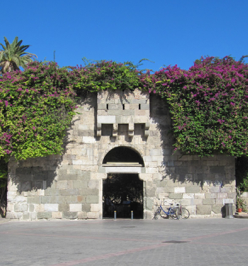
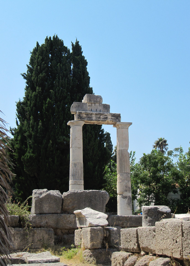
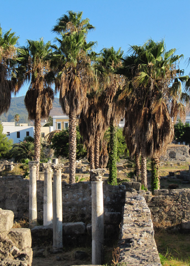
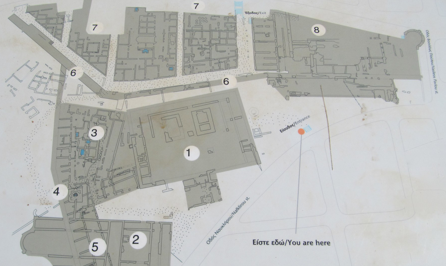
PHOTOS: Top Three: 1. The Old Agora Site in the center of the Town of Kos. 2. An archaeological dig with ruins of an old village, near the harbor. The building is a “modern” Greek house. 3. Remnants of the Old Agora at the archaeological site. Center Two: 1. Map of the Old Angora site in the center of Kos. The numbers on the map represent the following:
1.Sanctuary of Aphrodite. 2. Harbor Basilica. 3. Sanctuary of Herakles. 4. Baptistery
5.Harbor Stoa. 6. Fortification. 7. Insulae. 8. Agora.
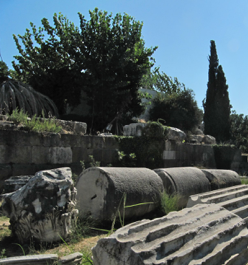
2. Ruins of Stone columns in the Old Agora site in Kos.
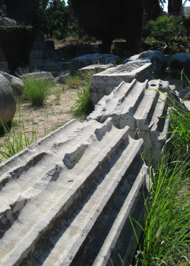
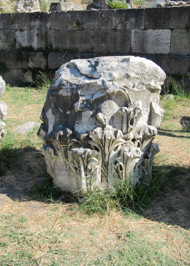
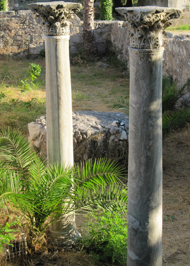
Bottom Three: 1. Standing Corinthian columns, part of the ruins of the Old Agora. 2. Ruins of the Old Agora. Many drums of stone that would have been columns lie on the ground. There is evidence of fluted columns that would have had Corinthian capitals as well as the plain columns that would probably have been in the Doric order. 3. A deeply carved Corinthian capital with its representation of acanthus leaves.

Ancient Market Place of Kos